Hong Kong Mahjong Faan Chart
The complete faan-to-points table for Hong Kong / Cantonese mahjong — every value from a 0-faan chicken hand up to the 13-faan limit, with what the discarder pays and what each player pays on a self-draw. These are exactly the numbers our Hong Kong calculator reports.
Faan to points, 0–13 faan
Convention shown: full-spicy (全辣) doubling — the hand value is 2^faan points, doubling on every single faan — with the full-payment (全銃) discardconvention and the standard 1.5× self-draw. The “hand value” column is the number the calculator displays; the payment columns split it. Common alternatives (half payment, the half-spicy ladder, lower caps) are covered below the table.
| Faan | Hand value (2^faan) | Discard — discarder pays | Self-draw — each of 3 pays | Self-draw — winner collects |
|---|---|---|---|---|
| 0 | 1 | 1 | 0.5 | 1.5 |
| 1 | 2 | 2 | 1 | 3 |
| 2 | 4 | 4 | 2 | 6 |
| 3 | 8 | 8 | 4 | 12 |
| 4 | 16 | 16 | 8 | 24 |
| 5 | 32 | 32 | 16 | 48 |
| 6 | 64 | 64 | 32 | 96 |
| 7 | 128 | 128 | 64 | 192 |
| 8 | 256 | 256 | 128 | 384 |
| 9 | 512 | 512 | 256 | 768 |
| 10 | 1,024 | 1,024 | 512 | 1,536 |
| 11 | 2,048 | 2,048 | 1,024 | 3,072 |
| 12 | 4,096 | 4,096 | 2,048 | 6,144 |
| 13 | 8,192 | 8,192 | 4,096 | 12,288 |
Points here are stake units, not dollars — tables map them to money (or chips) via an agreed base. Most tables enforce a 3-faan minimumto declare, so the 0–2 faan rows rarely pay out; the 0-faan “chicken hand” (雞糊, 1 point) is what the calculator shows when a winning hand scores no patterns at all. Anything above 13 faan is capped: the calculator computes 2^faan on the capped value, so a 15-faan hand still pays 8,192.
Reading the chart: a 7-faan self-draw
An open hand of bamboo pungs plus a White Dragon pair: All Pungs and Mixed One Suit are 3 faan each, and winning by self-draw with an open hand adds 1 more.
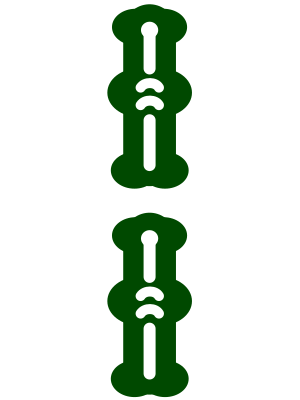
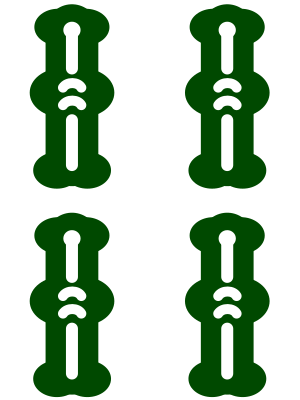
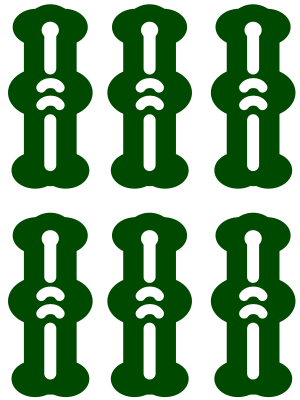
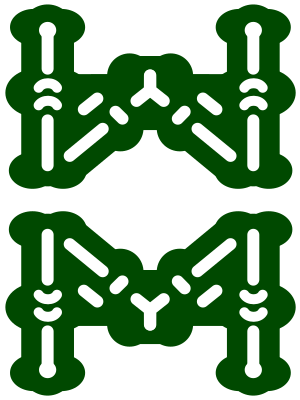
 win
win- All Pungs (對對糊)3 faan
- Mixed One Suit (混一色)3 faan
- Self Draw (自摸)1 faan
- Total — 2^77 faan · 128 points
Read the 7-faan row: the hand is worth 128. Because this win is a self-draw, each of the three opponents pays 64, so the winner collects 192. Had someone discarded the 8s instead, the discarder would pay the full 128 under full payment — or 64 with the other two players paying 32 each under half payment.
Common table rules and variations
Minimum faan (3 faan). Nearly every Hong Kong table requires at least 3 faan to declare a win — 8 points, the first row where the payout feels earned. Stricter tables play a 5-faan minimum; looser family games allow 1 faan or even chicken hands. The calculator detects every faan regardless of minimum so you can see what your hand is worth either way.
Half payment vs full payment. Both conventions hand the winner the same total on a discard win — they differ in who pays it. Under full payment (全銃, shown in the chart) the discarder pays the entire hand value alone. Under half payment (半銃) the discarder pays half and the other two players split the rest: on an 8-faan, 256-point hand, that is 128 from the discarder and 64 from each of the others. Self-draws are the same under both: every player pays half the hand value, 1.5× total.
Half spicy vs full spicy. The chart above uses full-spicy (全辣) doubling — every faan doubles the payout, exactly as the calculator computes it. Many money tables soften the top end with the half-spicy (半辣上) ladder, which doubles only every two faan above 4:
| Faan | 4 | 5 | 6 | 7 | 8 | 9 | 10 | 11 | 12 | 13 |
|---|---|---|---|---|---|---|---|---|---|---|
| Full spicy (this site) | 16 | 32 | 64 | 128 | 256 | 512 | 1,024 | 2,048 | 4,096 | 8,192 |
| Half spicy (半辣上) | 16 | 24 | 32 | 48 | 64 | 96 | 128 | 192 | 256 | 384 |
Faan caps (laak, 辣). The cap is where the table stops doubling. This chart and the calculator cap at 13 faan = 8,192 points, which is where the classic limit hands — Thirteen Orphans, Great Four Winds, Nine Gates, Four Concealed Pungs — all land. Plenty of tables cap lower: 8 faan (256 points) keeps games tame, and 10 faan (1,024 points) is a popular middle ground. Whatever the cap, hands above it pay the cap value — the calculator still lists every faan it detected so you know your true total.
Flowers and seasons (花牌). The calculator follows the mainstream bonus-tile convention: each flower or season matching your seat (正花) is worth 1 faan — East matches Spring/Plum, South matches Summer/Orchid, West matches Autumn/Chrysanthemum, North matches Winter/Bamboo — and a complete series of all four seasons or all four plants (一台花) is worth 2 faan, replacing the own-flower faan within that series. Popular variations — 1 faan for finishing with no bonus tiles (無花), 3 faan for seven of them, an outright limit for all eight (八仙過海) — are house rules the calculator does not count.
Agree on all four knobs — minimum, payment convention, spicy ladder, and cap — before the first deal. Every serious dispute at a Hong Kong table traces back to one of them.
Faan chart questions
How many points is a 3 faan hand in Hong Kong mahjong?+
A 3-faan hand is worth 2^3 = 8 base points. Won off a discard under full payment (全銃), the discarder pays all 8. Under half payment (半銃), the discarder pays 4 and the other two players pay 2 each. On a self-draw, each of the three players pays 4, so the winner collects 12 — 1.5 times the hand value.
What's the difference between half spicy (半辣) and full spicy (全辣)?+
They are two doubling ladders above 4 faan. Full spicy keeps doubling every faan: 5 faan = 32, 6 faan = 64, 7 faan = 128, up to 13 faan = 8,192. Half spicy doubles every two faan instead: 5 faan = 24, 6 faan = 32, 7 faan = 48, 10 faan = 128, and 13 faan = only 384. This chart and our calculator use the full-spicy 2^faan ladder.
Who pays when someone wins in Hong Kong mahjong?+
Take a 5-faan hand worth 32 points. If won off a discard: under full payment the discarder pays the whole 32; under half payment the discarder pays 16 and the other two players pay 8 each — same 32 total either way. If won by self-draw, every player pays half the hand value: 16 each from all three, so the winner collects 48 (1.5× the discard total).
What is the faan cap (laak) in Hong Kong mahjong?+
Most tables cap payouts at a limit called the laak (辣). This chart and our calculator cap at 13 faan = 8,192 points, which covers every classic limit hand (Thirteen Orphans, Great Four Winds, Nine Gates). Other common caps are 8 faan (256 points) and 10 faan (1,024 points) — anything above the cap pays the same as the cap.