Hong Kong Mahjong Calculator
Score Hong Kong / Old-Style Cantonese (港麻) hands with full faan detection — including every classic limit hand — exponential 2^faan payouts, seat and round winds, dragon pungs, and live shanten + waits. No signup, runs in your browser.
Enter the flipped indicator tile from the wall — the tile after it is the dora, and each dora in your hand is worth +1 han. Tap a chosen indicator to remove it.
Special circumstancesdouble riichi · haitei/houtei · rinshan/chankan
8 tiles away from tenpai.
The last tile you add is treated as the winning tile — tap any tile in your completed hand to change it.
What is Hong Kong / Cantonese mahjong?
Hong Kong mahjong — also called Old-Style Cantonese or 港麻 — is the casual variant most widely played at home tables in Hong Kong, Guangdong, and across the Cantonese-speaking diaspora. It’s the version most people learn first, and the one you’ll see at Sunday family games.
Scoring works on faan (番) — about 28 distinct patterns ranging from 1 faan (Self Draw, Concealed Hand) up to 13 faan limit hands like Great Four Winds, Thirteen Orphans, and Nine Gates. Payouts scale exponentially: each faan doubles your score, so a 7-faan hand pays 128 base units while a 13-faan hand hits the table limit.
Most tables enforce a 3-faan minimum to declare a win — enough to earn 8 base units. The calculator detects everything regardless of minimum so you can see exactly how close your hand got to scoring.
All HK faan patterns by tier
Every Hong Kong faan rule with its point value. Tap any pattern for the rule, a worked example hand, and related patterns at the same faan value.
Scoring a Great Three Dragons hand
The classic 8-faan hand: pungs of all three dragons (White, Green, Red) plus one more set and a pair. Even without considering other faan, this alone pays 256 base units.

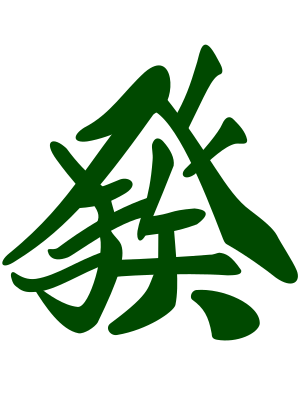
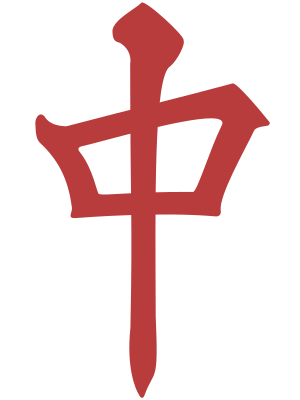
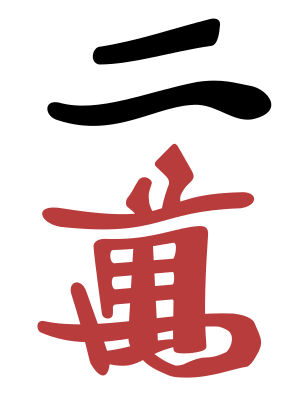
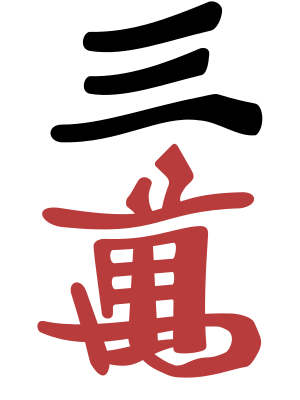
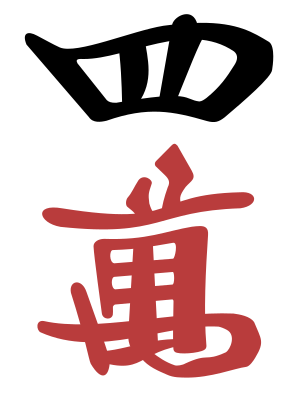
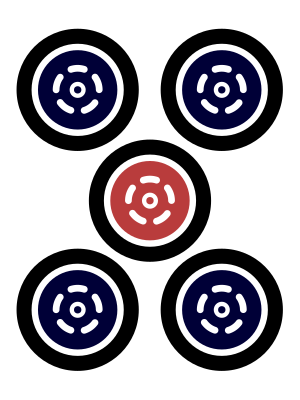 win
win- Great Three Dragons (大三元)8 faan
- Concealed Hand (門前清)1 faan
- Total — 2^99 faan · 512
Common Hong Kong scoring questions
What is Hong Kong (Cantonese) mahjong?+
Hong Kong mahjong — sometimes called Old-Style Cantonese — is the casual variant most widely played in Hong Kong, Guangdong, and across the Cantonese diaspora. It uses ~28 faan (番) scoring patterns and pays out exponentially: each faan doubles your score. The standard cap is 13 faan, where most tables call it 'limit' and pay a fixed amount.
How does the exponential 2^faan payout work?+
Each faan doubles the base point unit. A 3-faan hand = 8 base units, 5 faan = 32, 7 faan = 128, 10 faan = 1,024, 13 faan = the limit at 2^13 = 8,192 — exactly what the calculator reports. Most home tables run 3-faan minimum to declare, so you almost always score 8 base units or more. The calculator shows both your faan count and the 2^faan payout.
What's the 3-faan minimum?+
By tradition, most Hong Kong tables require at least 3 faan to declare a winning hand — that's roughly the threshold where the hand has earned a meaningful score. Common 3-faan hands include All Pungs (對對糊) and Mixed One Suit (混一色). The calculator detects every faan you've earned regardless of minimum so you can see how close you got.
What are the classic limit hands?+
The 13-faan limit hands are Great Four Winds (大四喜), Thirteen Orphans (十三么), Nine Gates (九蓮寶燈), Four Concealed Pungs (四暗刻), and the Blessing of Heaven / Earth (天糊/地糊). Just below the limit sit All Honors (字一色) and All Terminals (清么九) at 10 faan, and Great Three Dragons (大三元) at 8. The calculator detects all of these from your tiles except Blessing of Heaven and Earth — those depend on when the win happened (first draw / first discard), so they're documented as reference only.
Do flowers and seasons count?+
Yes — each flower or season matching your seat (正花) scores 1 faan: East matches Spring/Plum, South matches Summer/Orchid, West matches Autumn/Chrysanthemum, North matches Winter/Bamboo. A complete series of all four seasons or all four plants (一台花) scores 2 faan for that series, replacing the own-flower faan inside it. Flowers are bonus tiles set aside before the round and don't affect the main hand structure — declare them in the calculator's flower input to get them credited.
How does HK differ from MCR or Riichi?+
HK is the most casual of the three — shorter faan list, exponential payouts that swing big, and a lower bar to declare. MCR uses 81 fan patterns with strict exclusion rules and an 8-fan minimum. Riichi adds the fu system, dora bonuses, and the unique riichi declaration. HK is what most families actually play; MCR and Riichi are the tournament variants.