Taiwanese Mahjong Calculator
Score Taiwanese 16-tile (台麻) hands across the 5-meld winning structure. Detects dragon and wind pungs, the three-dragon and four-winds hands, flushes, All Pungs and All Honors, the concealed-pung ladder (三暗刻/四暗刻/五暗刻), 門清一摸三, the dealer tai, seat flowers — and live shanten + waits on the way to tenpai. No signup.
Enter the flipped indicator tile from the wall — the tile after it is the dora, and each dora in your hand is worth +1 han. Tap a chosen indicator to remove it.
Special circumstancesdouble riichi · haitei/houtei · rinshan/chankan
8 tiles away from tenpai.
The last tile you add is treated as the winning tile — tap any tile in your completed hand to change it.
What is Taiwanese 16-tile mahjong?
Taiwanese mahjong (台灣麻將) is the variant played throughout Taiwan, southern Fujian, and across the Hokkien diaspora. It’s the rule set most Taiwanese learn at the family table, and the format used at most Taiwan-based tournaments.
The defining feature is the 16-tile hand: a winning hand is 17 tiles total (5 melds + 1 pair), not the standard 14 (4 melds + pair) used in Hong Kong, MCR, and Riichi. That single extra meld changes everything — draws happen faster, pungs and chows compete for one more slot, and classic hands like All Pungs or Pure One Suit are slightly harder to reach.
Scoring works on tai (台) — flat pattern values ranging from 1 tai (self-draw) up to 16-tai limit hands like Great Three Dragons, All Honors, and Big Four Winds. Money is settled as 底 + 台: each loser pays an agreed base stake (底) plus the winner’s tai count times an agreed per-tai rate, both set by the table before play.
All Taiwanese tai patterns
Every Taiwanese tai pattern grouped by value. Tap any pattern for the rule, a worked example hand, and related patterns at the same tier.
Scoring Pure One Suit + All Pungs + Five Concealed Pungs
A 16-tile manzu-only pungs-only hand, all five pungs drawn by hand and the win by discard on the pair tile. Taiwanese counting is additive, so the structural patterns stack with the concealed-pung ladder and the concealment bonus.
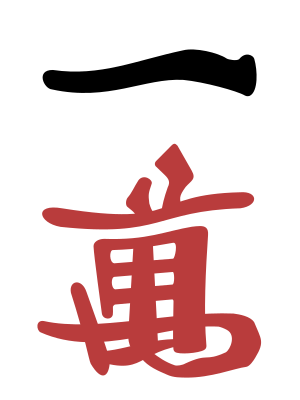
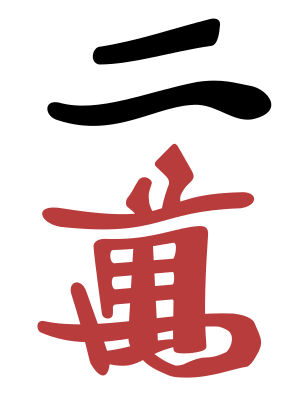
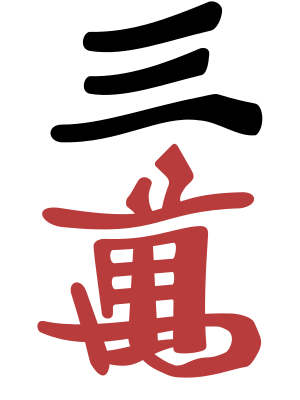
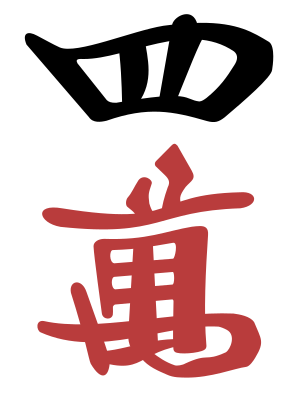
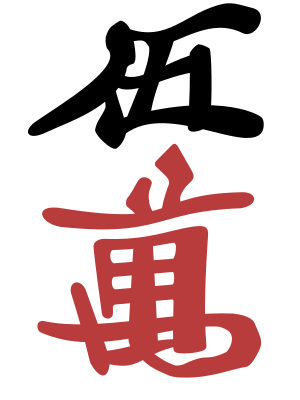
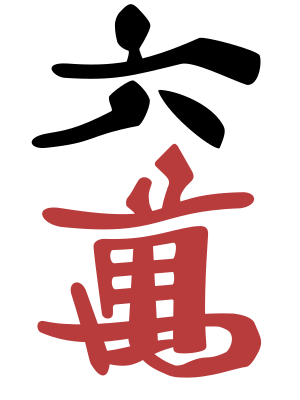 win
win- Pure One Suit (清一色)8 tai
- All Pungs (碰碰胡)4 tai
- Five Concealed Pungs (五暗刻)8 tai
- Fully Concealed (門清)1 tai
- Total21 tai
Common Taiwanese mahjong questions
What is Taiwanese (16-tile) mahjong?+
Taiwanese mahjong — 台灣麻將 or 台麻 — is the variant played throughout Taiwan and across much of the Hokkien diaspora. The defining feature is the 16-tile hand: instead of the standard 14 (4 melds + 1 pair), a winning hand is 17 tiles (5 melds + 1 pair). That extra meld changes every aspect of strategy, from drawing speed to fan structure.
How does tai scoring work?+
Each scoring pattern is worth a number of tai (台), and the hand total is the simple sum. Dragon Pung is 1 tai, All Pungs is 4, Pure One Suit is 8, and hands like Big Four Winds or All Honors reach 16. One convention worth knowing: a concealed hand won by self-draw scores the combined 門清一摸三 at 3 tai total, not Fully Concealed 1 + Self Draw 1. Money is settled as 底 + 台: each loser pays an agreed base stake (底) plus your tai count times an agreed per-tai rate — the base and rate are set by the table, so the same tai total pays differently at different tables.
Why does Taiwanese mahjong use 17 tiles to win?+
Taiwanese variant evolved with an extra meld baked in — 5 melds plus a pair instead of 4 plus a pair. Hands are larger, draws happen faster, and the standard "all pungs" or "pure one suit" combinations are slightly harder to reach because there's one more set to fill.
Do flowers and seasons matter in Taiwanese mahjong?+
Yes — flowers are central to Taiwanese scoring, and only the right ones pay. The seat-matching 正花 — the season or plant whose number matches your seat (East 1, South 2, West 3, North 4) — scores 1 tai each; other flowers alone score nothing under the standard convention. Collecting a complete series of four (春夏秋冬 or 梅蘭竹菊) is a 2-tai 花槓, and all eight flowers is 八仙過海 at 8 tai, usually winning the hand on the spot. Flowers are drawn separately from the wall and don't enter your main 17-tile hand.
Are there limit hands like in Hong Kong?+
Yes — Taiwanese rules have several 16-tai hands at the top of the 台數表: All Honors (字一色), Big Four Winds (大四喜), and — by common convention — Heavenly Hand (天胡, dealer wins on the opening deal) and Earthly Hand (地胡). This calculator detects All Honors and Big Four Winds; Heavenly and Earthly Hands depend on deal timing the calculator doesn't track, so count those at the table. Note that Thirteen Orphans is a 13-tile-game hand and does not exist in 16-tile Taiwanese rules.
How does Taiwanese differ from Hong Kong, MCR, and Riichi?+
The 16-tile (17 with pair) structure is unique to Taiwanese. Hong Kong uses 14 tiles with faan. MCR uses 14 tiles with 81 fan patterns. Riichi uses 14 with han + fu. Taiwanese scoring is closest in spirit to Hong Kong — flat tai counts, doubled by the larger hand — but the table economics and flower mechanics are very different.