Riichi Mahjong Calculator
Score Japanese Riichi (立直) hands with full han + fu calculation, every yaku from pinfu to kokushi musou, dora and akadora bonuses, riichi and ippatsu — and live shanten + wait tracking on the way to tenpai. No signup, runs in your browser.
Enter the flipped indicator tile from the wall — the tile after it is the dora, and each dora in your hand is worth +1 han. Tap a chosen indicator to remove it.
Special circumstancesdouble riichi · haitei/houtei · rinshan/chankan
8 tiles away from tenpai.
The last tile you add is treated as the winning tile — tap any tile in your completed hand to change it.
What is Japanese Riichi mahjong?
Riichi mahjong is the Japanese variant played at the World Riichi Championship and across the European Mahjong Association tour. It evolved out of post-war Japanese mahjong in the 1950s and has been the dominant competitive ruleset in Japan since.
What makes Riichi distinct is its two-axis scoring system: han (役) counts your scoring patterns, and fu (符) adds small bonuses for hand structure — closed pungs, terminal triplets, wait shape, and so on. Your point total scales as roughly fu × 2^(han + 2), hard-capped at mangan (~8,000 pts) and four progressively higher limits up to yakuman.
The signature mechanic is the riichi declaration: bet 1,000 points on a closed tenpai, freeze your hand, and gain a guaranteed bonus han plus shots at ippatsu and ura dora. The calculator wires up every yaku from pinfu to kokushi musou and applies the standard limit-hand caps.
Every yaku by han value
Every standard Riichi yaku grouped by closed-hand han value — yaku that lose value when opened show both numbers. Tap any yaku for the rule, a worked example, and related patterns at the same tier.
Scoring a Tanyao + Pinfu hand
A clean closed hand combining two of the most common riichi yaku. The 2-3 of souzu is a two-sided (ryanmen) wait on 1s or 4s — pinfu requires exactly that kind of open chow wait plus a non-yakuhai pair. Winning on 4s also keeps every tile a simple, so tanyao holds (a 1s win would drop it).
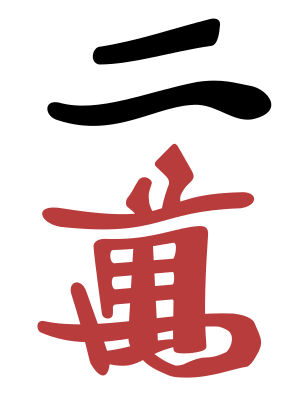
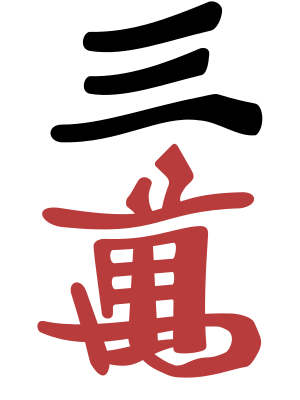
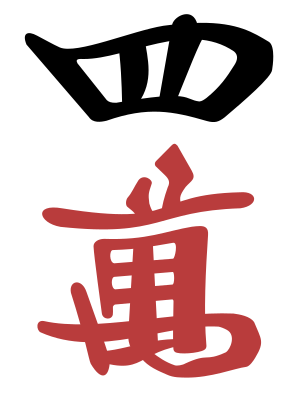
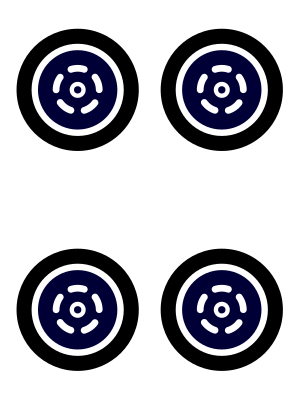
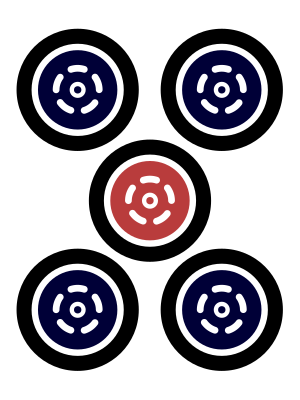
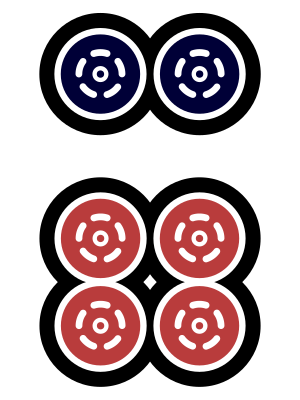
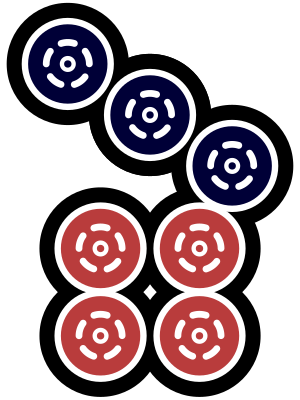

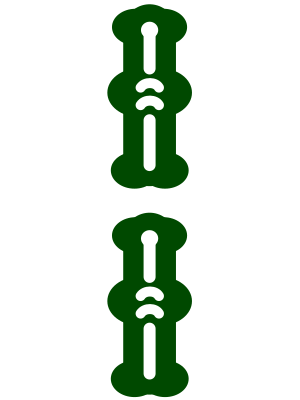
 win
win- Pinfu (平和)1 han
- Tanyao (断幺九) — no terminals or honors1 han
- Total — closed ron, 30 fu (20 base + 10 menzen ron)2 han · 2,000
Common Riichi scoring questions
What is Riichi mahjong?+
Riichi (立直) is the Japanese variant of mahjong played at the highest competitive level in Japan and across the EMA tour. It uses a unique two-axis scoring system — han (similar to fan) multiplied against fu (small points for hand shape and waits) — plus the signature riichi declaration that bets 1,000 points for a closed-hand tenpai bonus.
What are han and fu?+
Han is awarded for each yaku (scoring pattern) your hand contains — riichi is 1 han, tanyao is 1 han, all-honors yakuman is 13 han, and so on. Fu is added up from small structural elements: 20 base, +4 for a closed pung of simples, +8 for a closed pung of terminals/honors (open pungs are worth half), +2 for closed-wait or single-wait, +10 for a closed-hand ron, etc. Your point total scales roughly as fu × 2^(han+2), with hard caps at mangan, haneman, baiman, sanbaiman, and yakuman.
What does riichi do, exactly?+
When you've closed your hand and reached tenpai (one tile from winning), you can declare riichi by placing 1,000 points sideways into the center. You gain a guaranteed 1 han bonus, a chance at ippatsu (1 more han if you win within one uninterrupted turn), and the ura dora reveal on your final wall tile — but you commit to not changing your hand for the rest of the round.
Does the calculator handle dora and akadora?+
Yes. Dora indicators add 1 han per matching tile in your hand. Akadora (red 5s — encoded as 0m/0p/0s in tile notation) automatically count as 1 han each. Enter your dora indicators in the calculator's context panel; akadora are detected from the red flag on individual tiles.
How are limit hands (mangan and above) handled?+
Once your raw score crosses the mangan threshold, point totals are capped at fixed values: mangan (5 han, or 3 han 70+ fu / 4 han 40+ fu hands over the base-point cap — exactly 8,000 points on a non-dealer ron), haneman (6-7 han), baiman (8-10 han), sanbaiman (11-12 han), and yakuman (13+ han or qualifying patterns like kokushi, suuankou, daisangen). The calculator applies these caps automatically and reports the limit name.
How is Riichi different from MCR or Hong Kong?+
Riichi uses han + fu and demands at least 1 yaku to declare. MCR uses a flat 81-fan list with an 8-fan minimum and strict exclusion rules — no fu. Hong Kong uses faan with exponential payouts (2 to the power of faan). Riichi has the most depth around concealment (closed-hand bonuses, ippatsu, ura dora), while MCR is the most precise scoring system.