Sichuan Mahjong Calculator
Score Sichuan / Bloody Battle (血战麻将) hands. No honor tiles, no chi calls (in-hand chow sequences still count), and the mandatory missing-suit constraint — the fastest variant of mahjong in widespread play. Live shanten + waits, full fan detection, and worked examples. No signup.
Enter the flipped indicator tile from the wall — the tile after it is the dora, and each dora in your hand is worth +1 han. Tap a chosen indicator to remove it.
Special circumstancesdouble riichi · haitei/houtei · rinshan/chankan
8 tiles away from tenpai.
The last tile you add is treated as the winning tile — tap any tile in your completed hand to change it.
What is Sichuan / Bloody Battle mahjong?
Sichuan mahjong (四川麻将 / 血战麻将) is the regional variant from southwest China — specifically Chengdu and Chongqing — that has become the dominant mobile mahjong format in China via apps like Tencent’s 欢乐麻将. It’s fast, brutal, and strategically tight.
Three rules define the variant:
- No honor tiles. Winds and dragons are removed from play. Only three numbered suits (m/p/s) are dealt.
- No chi calls.You can’t claim a chow from another player’s discard. But chow sequences that you assemble yourself from your own draws are perfectly valid winning melds. The famous All Pungs (碰碰胡) pattern is a 2-fan scoring bonus when every meld happens to be a pung or kong — not a structural requirement.
- Missing one suit (缺一门).Each player commits to one of the three suits as their “missing” suit and must discard every tile of that suit before they can declare victory. Your winning hand can’t contain a single tile of your missing suit.
Scoring is exponential like Hong Kong — total payout = 2 to the power of total fan, capped at 16 fan. Most rounds finish in 5-10 minutes, much faster than MCR or Riichi. The defining big hand is Pure Dragon Seven Pairs (清龙七对) at 8 fan.
Every Sichuan scoring pattern
Sichuan’s shorter pattern list (vs MCR’s 81) — but with exponential payouts, you don’t need many fan to score a big hand.
This chart is one common convention — Sichuan tables vary. Some popular rule sets start the basic win at 0 fan and score a kong purely as its root (根) instead of separate concealed/melded kong fan; this chart keeps Basic Win at 1 fan and counts kong fan and roots separately, applied consistently by the calculator. Heavenly Hand, Earthly Hand and Kong on Discard are documented for reference only — the calculator can’t detect deal or discard timing, so score those by rule at the table.
Scoring a Pure One Suit hand
Four pungs of odd manzu plus a pair of 9m — all in a single suit, missing souzu. Triggers Basic Win (1 fan), All Pungs (2 fan), Pure One Suit (2 fan), Concealed Hand (1 fan) and Self-Draw (1 fan) for a 7-fan total = 128 base points.
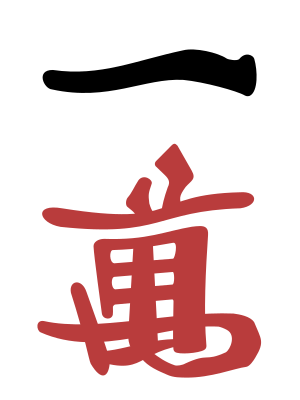
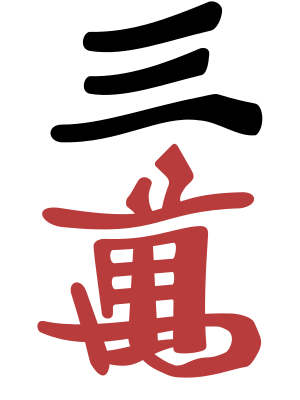
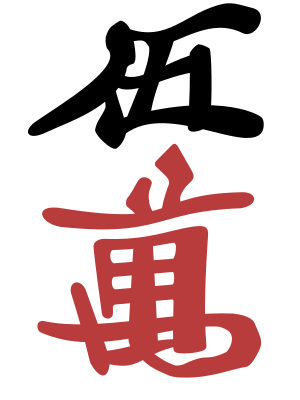
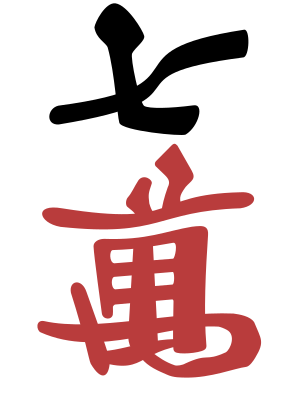
 win
win- Basic Win (基本胡)1 fan
- All Pungs (碰碰胡)2 fan
- Pure One Suit (清一色)2 fan
- Concealed Hand (门清)1 fan
- Self Draw (自摸)1 fan
- Total — 2^77 fan · 128
Common Sichuan mahjong questions
What is Sichuan / Bloody Battle mahjong?+
Sichuan mahjong — 四川麻将 or 血战麻将 (Blood-Battle Mahjong) — is the wildly popular regional variant from Sichuan Province in southwest China. It's the variant played in millions of homes across Chengdu and Chongqing, and the most-downloaded mahjong app variant in China (the Tencent Sichuan Mahjong app alone has hundreds of millions of users).
What's the 'missing one suit' (缺一门) rule?+
Before each round, every player commits to discarding all tiles of one of the three suits — manzu, pinzu, or souzu. You're stuck without that suit for the entire round. The winning hand cannot contain a single tile of your missing suit. This single rule forces aggressive defensive play and makes Sichuan mahjong famously fast-paced.
Can I form chows in Sichuan?+
Yes — in-hand chow sequences (assembled from your own draws) are perfectly valid winning melds. What Sichuan disallows is the chi DECLARATION — you cannot call 'chi!' to claim another player's discard for a chow. All your chows must be formed from tiles you drew yourself. The All Pungs pattern (碰碰胡) is a 2-fan scoring bonus when every meld happens to be a pung or kong, but it isn't a structural requirement.
Why no honor tiles?+
Sichuan rules remove the seven honor tiles (East, South, West, North, White, Green, Red) from the wall entirely. Combined with the missing-suit rule, you effectively play with only two of the three numbered suits — which is why hands close faster than in other variants.
How does scoring work?+
Each scoring pattern is worth a number of fan (番), and the total is exponentially compounded — 2 to the power of total fan = your base point payout, capped at 16 fan (65,536 points). Patterns include Concealed Hand (1 fan), Self-Draw (1 fan), roots (根, +1 fan for each four-of-a-kind you hold), Seven Pairs (2 fan), Pure One Suit (2 fan), Golden Hook (2 fan), and limit hands like Pure Dragon Seven Pairs (8 fan) and Eighteen Arhats (16 fan).
What's 'Bloody Battle' (血战到底)?+
The Bloody Battle variant — most popular online — keeps the round going after the first winning hand instead of ending. When one player wins, the round continues for the remaining two non-winners until either someone else wins or the wall runs out. The 'blood' refers to losers continuing to pay each new winner.
How is this different from MCR or Hong Kong?+
Sichuan is the most extreme of the Chinese variants: no honor tiles, no chi calls (in-hand chows are still fine), and the mandatory missing-suit constraint. MCR uses all chows + honors + 81 fan patterns with strict additive scoring. Hong Kong uses chows + honors + ~27 faan with exponential payouts but no missing-suit rule. Sichuan is faster and simpler — most rounds finish in 5-10 minutes.